240 recorded answers · ChatGPT · Google AI
Buyers ask ChatGPT which dealer to trust. Are you the answer?
AI names two or three dealers in your city, that’s it. We show you who it’s naming, work out exactly why they win — and hand you the playbook to get your dealership named.
Start freePlaybook in 24 hoursNo contracts
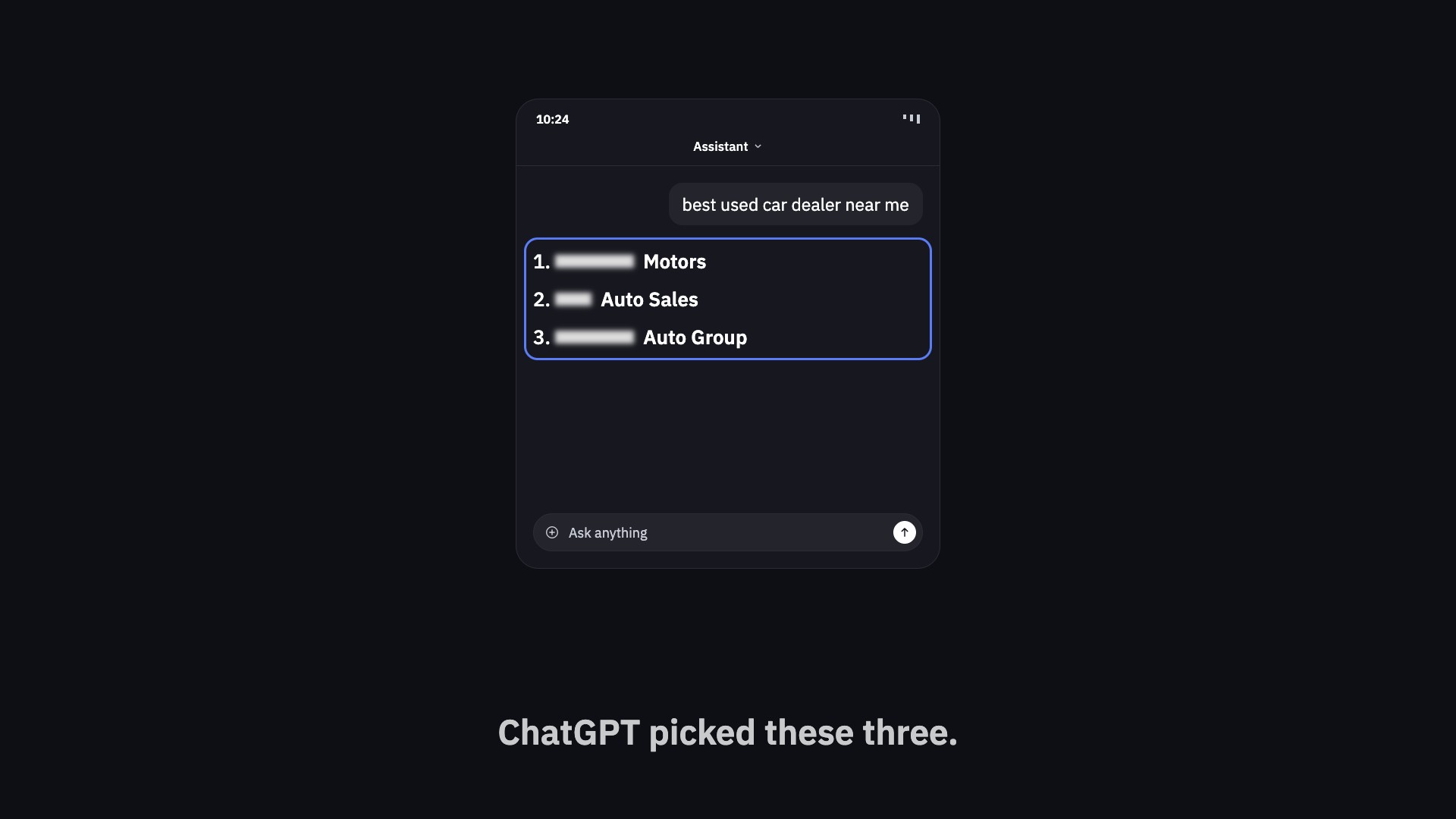
Your next customer may never search Google.
Buyers increasingly skip the search box and just ask. One question, one answer, two or three dealer names. There is no page two.
Questions buyers actually type
- What’s the best used car dealership near me?
- Which dealers in Phoenix have the best reviews?
- Where should I buy a reliable used Toyota?
This isn’t coming. It already happened.
Shoppers have already moved. Most independent dealers haven’t — which is the whole opportunity, and the whole risk.
63%
of shoppers plan to use AI to shop for their next vehicle.
Cox Automotive
30%
already used generative AI during their last vehicle research — ChatGPT dominated.
EKHO
You’re already paying for marketing. None of it reaches this.
Not because any of it is bad. Because an AI answer is built somewhere none of it operates — and every one of those channels is doing exactly what you bought it for.
CarGurus, Cars.com, Autotrader
Puts your inventory in front of buyers browsing those sites.
AI reads their dealer lists, not your ad spend. Paying more does not change what it sees.
Your SEO agency
Works on where you land in Google’s ten blue links.
The answer is assembled before the links appear.
Your website redesign
Changes what a buyer sees once he is already on your site.
The answers we record cite directories and reviews far more than dealership sites.
Facebook and paid social
Buys attention from people scrolling.
Nothing there is a source an AI cites.
“Who has the best selection of used trucks near me?”
AI names three dealerships. He calls one of them. You paid for leads all month — this one never became one.
- Missed callNone
- Form submissionNone
- CRM recordNone
What does decide it
AI doesn’t rank you. It reads about you.
There is no results page to climb. The answer is written from whatever pages describe dealerships in your city — so the question isn’t where you rank, it’s whether those pages say anything about you at all.
The pages it actually reads
- Review platforms and directories — Yelp, Birdeye, Carfax, Yellow Pages
- Bing and Google business listings, and whether they agree with each other
- “Best of” round-ups and local blogs that name dealerships
- Local press and forums that are still alive in your metro
- Ordinary web pages that describe what you specialize in, in words
You can be on every one of these and never know it, because nothing on that list reports back to you.
Case file · San Jose, CA · August 2026
We asked. Then we opened every page behind the answer.
13
Sources behind the answer
Review aggregators, directories and “best of” round-ups.
0
Dealership websites among them
Every dealer named has one. Not one was read.
We asked ChatGPT which dealership to buy a used car from in San Jose. It named one big chain and five independents — then cited thirteen pages, not one of them a dealership’s own website. The answer was assembled from what other people had written about those dealers.
One independent came out top of both curated lists it cited. The single distinguishing thing ChatGPT said about that dealer — “worth considering if financing is important” — traces almost word for word to a paragraph on a directory the dealer does not own.
And the chain with the most reviews came ninth. It had 1,624 of them at 4.2; the independent above it had 608 at 4.8. On the page the AI actually read, rating beat volume — which is the opposite of the advice every dealer has already been given.
You give us your website and an email. We do the rest.
Nothing to install, and no logins needed from you to get started.
01
We ask
Sixty questions in the words your buyers use, localized to your city — asked three times each on ChatGPT and once through Google AI Mode, because AI answers move.
02
We analyze
A person reads all 240 answers, checks every source by hand, and throws out anything we can’t back up.
03
You get the playbook
Where you stand, why the dealers beating you win here, and the fixes in the order to make them — in your inbox within 24 hours, written so you can act on it or forward it.
Start with the free scan — your email and website are all we need.
The playbook · what lands in 24 hours
Not another vanity score. The whole strategy.
What’s true, what’s missing, and what to do about it — in the order we’d work it. In your hands within 24 hours — the first move toward showing up when buyers ask.
 The verdict
Where you stand. How many of 240 answers named you, and how you compare with the lots around you.
 Share of answers
Who’s getting named. How often AI picks you versus every rival, counted from the answers — and who it recommends in your place.
 The evidence
What decided it. The exact pages AI read before deciding — the winners’ own pages it cited, the sites it trusts in your market, and whether it can read your website at all.
 The fixes
Written, in three tiers. What you can do today yourself, a ready-to-forward ticket for your website vendor, and drafted pages for the questions no dealer owns yet — every fix written to paste, not described.
Human review — sources opened and checked by hand, competitor names verified as real local lots, defamation scan, no automated scores. The re-measure, included — around day 60 we run your whole battery again, same questions, same method, and send you the before and after. You see what moved.
Read the full sample playbook — all 14 pages (PDF)
Pages shown are from a demonstration report for a fictitious dealership, stamped SAMPLE — the platforms are real, the dealers and numbers are not. Your playbook contains only real, timestamped model outputs for your market.
Find out for free. Fix it when you’re ready.
Start with the free scan if you want proof there is a problem. Take the playbook when you want the whole picture and the steps to fix it. One-time prices, no sales call at either tier.
Free scan
$0
10 questions · 3 runs · ChatGPT
Does ChatGPT name your store — or the one down the street? In your inbox within 24 hours.
- 10 buyer questions, asked 3 times in a fresh chat
- Named, not named, or named wrong — question by question
- Who got the mention instead of you
- ChatGPT only · no sources · no playbook
No card required
The playbook
Dealership AIO Playbook
$399One-time
60 questions · 240 answers · 2 engines
Where you stand, who AI names instead, what it gets wrong about you, and the steps to fix it — written for your store.
- 60 buyer questions × 3 runs on ChatGPT
- The same 60 through Google AI Mode
- How often you’re named, against every rival that appears
- The role AI gives each of them — and the one it gives you
- Every website and listing it used to decide, read by hand
- What it gets wrong: hours, address, inventory, closed-when-open
- The playbook: what to fix, in the order to fix it
- Your descriptions and review replies, written to copy-paste
- A page you can forward to your website vendor
- All 240 answers, unedited and timestamped
- Human reviewed before it ships
- We write it, you paste it — we never log in to your accounts
One payment · in your inbox within 24 hours
Questions dealers ask
Do people really ask AI which dealer to go to?
Cox Automotive puts 63% of shoppers as planning to use AI to shop for their next vehicle, and EKHO found 30% already used it during their last vehicle research — ChatGPT most of all.
What is AI visibility? Is that the same as GEO?
Same thing, two names. GEO — generative engine optimization — is the work of being present, accurate, and recommendable in the answers AI assistants give, the way SEO is the work of ranking in a list of links. We do the dealership version: measure what ChatGPT and Google's AI say about your market, then hand you the fixes.
Is this just SEO with a new name?
It overlaps, but the evidence is different. ChatGPT reads Bing, Yelp and review text on ordinary websites — we’ve traced recommendations to sources no SEO report looks at. And unlike a retainer, this ends: one payment, one playbook.
What do you need from me?
Your website and an email address, nothing else. We read your name, your city and your inventory off the site ourselves. No logins, no installs, no call.
I don’t run my own website. Can I still use this?
Yes. The playbook includes a page written for whoever does — the exact fixes, in language a website vendor can action as a ticket. And most of what moves AI answers sits off your website anyway: listings, profiles, and the local sites AI reads, which you control directly.
Can you guarantee I’ll get recommended?
No, and nobody honest can. What we guarantee is the work: 60 questions across both engines, every answer handed over in full, and every fix written out in the order to make it. What an engine says tomorrow is not ours to promise.
Why $399? What’s the catch?
One payment, nothing renews. Asking the questions is automated, which is why it is fast. What you are paying for is a person reading all 240 answers, checking every source by hand, and writing the fix list for your store — not a score from a dashboard.
What if AI already recommends me?
Then you get good news with proof attached — and the playbook becomes about keeping the spot: the sources holding you up, and where a rival is closing in.
How long until anything changes?
Listings update quickly, but AI answers rebuild on a schedule nobody outside the labs controls — most changes take 30 to 90 days to surface. Anyone who tells you otherwise is selling.
Who sees my report?
You. It lives at a private link only you receive. We never publish your results or use your name in our marketing.
Find out what AI tells your buyers. Before another month of it.
Start free · playbook in 24 hours · no contracts